Fewer supporters carry cash every year. We break down what the shift means for collections, and the simple steps to meet donors where they already are.
Contactless giving is no longer a nice-to-have — it is quickly becoming the default way people give small, spontaneous gifts. Charities that still rely solely on cash tins are watching those gifts disappear, not because people care less, but because they simply are not carrying coins.
The good news is that meeting donors where they already are does not require a big technology project. A single tap-to-donate device on a counter or at an event can capture gifts that would otherwise be lost entirely.
Why the drop-off is bigger than it looks
Cash usage has fallen every year for over a decade, but the pace has picked up sharply since 2020. For most people, a wallet with no coins in it is not a lifestyle choice — it is simply how they now live. Card and phone payments cover almost everything from a coffee to a bus fare, so cash becomes the exception rather than the rule.
For a street collector or a shop-counter tin, that shift is invisible until you look at the numbers. Footfall might be exactly the same as last year, yet the total collected quietly drops, because the people walking past have nothing to drop in.
“The gift was never declined. It was never offered, because there was nothing to give with.”
What "meeting donors where they are" actually looks like
In practice, this means having at least one contactless option everywhere a supporter might feel the impulse to give: at the till, on the doorstep, at the event stand, or on the fundraising page they were sent a link to. Each of these is a different moment, but they share the same requirement — the ask has to be as fast as the impulse.
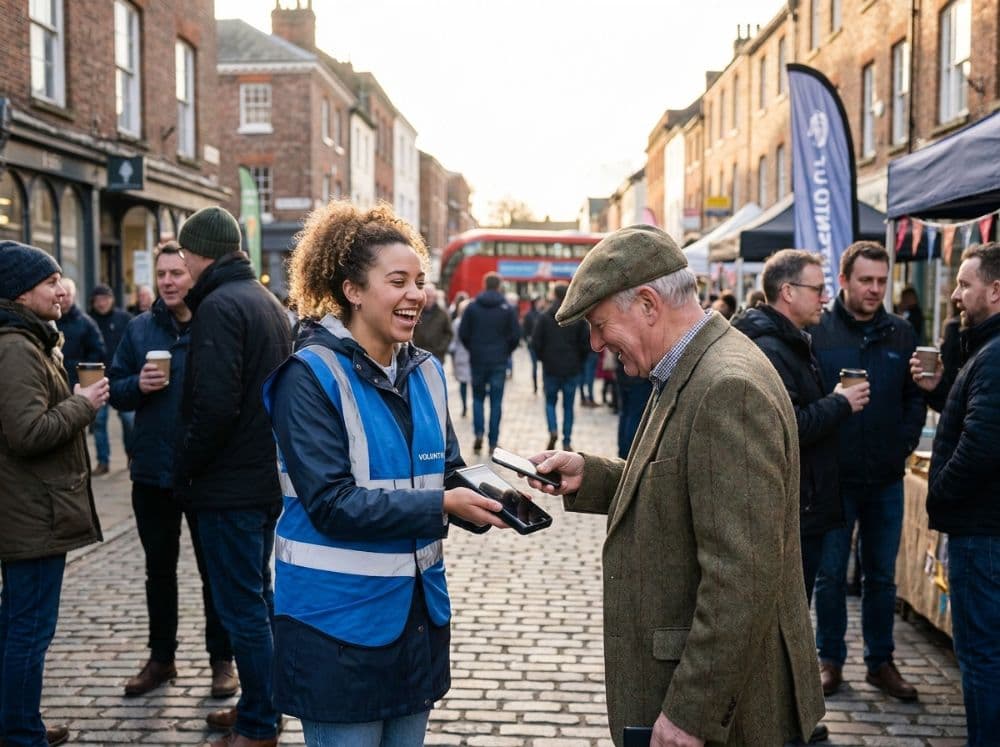
A tap-to-give device removes every point of friction between "I want to help" and "I have helped." No app to download, no card details to type, no need to carry the right change. That immediacy is what recovers the gifts that cash tins are quietly losing.
Getting started without a big project
You do not need to replace every collection method overnight. Most charities start with a single device in their highest-footfall location — a shop counter, a reception desk, or a regular market stall — and expand from there once they see the difference in average takings.
Pair that device with automatic Gift Aid capture at the point of tap, and every eligible contactless gift also claims the extra 25% without any additional paperwork on your side.
The high street will keep moving further away from cash. The charities that adapt now are the ones that will keep collecting comfortably in five years — not because they did anything complicated, but because they made it just as easy to give as it always used to be.